









By Hayley Mitchell
GUERNSEY COUNTY, Ohio (AVC News) — Despite deep family roots in Southeast Ohio, many young residents are already planning their exit. A recent AVC News survey reveals that more than 4 in 10 students don’t plan to stay in the communities they grew up in—citing a lack of things to do, limited job prospects, and the growing struggle to afford a basic standard of living. As local malls empty out, fast food chains vanish, and entertainment options dwindle, young adults are left asking: Why stay?
As part of the research for this article, we reached out to Bill Arnett, a member of the Youth Retention and Attraction Task Force. It is part of the Guernsey County Strategic Planning process, and has been working on a report to develop a strategy to attract young families to the area.
“We’re facing population decline in the county,” Arnett admitted. “We’re older on average than the state, so we need to do something to keep the young people we have and attract more”.
Their strategy for talking to the young adults in the area included hosting a public forum and speaking to members of the Young Professionals of Guernsey County. There are two main faults with this strategy. A public forum is a great idea in theory, but when the young adult interviewees were asked if they stayed up to date with their local government, very few people said they did. It is also incredibly difficult to find out what young adults would need to stay in the area when you are only talking to Young Professionals, who have presumably already chosen to settle in the area and have established a full-time career. Not to mention it ignores the generation of high school and college students who may be on the fence about whether or not they will come back to the area after graduation who don’t have full-time jobs yet.
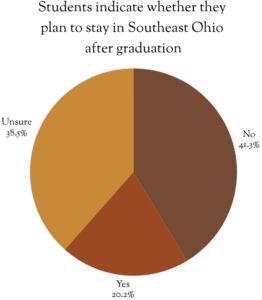
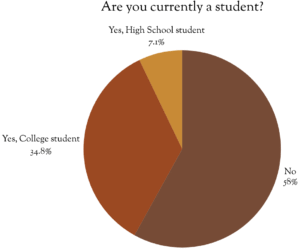
Interviewing people who have already decided to stay in the area instead of focusing on the needs of those who are unsatisfied and wanting to leave will not help the retention rates in the county. In this article, we chose to reflect on the opinions of both those who want to stay and those who want to go to recognize the main issues of Southeastern Ohio and get to the heart of why young adults are leaving the area en masse. One of the most common themes that drives people out of the area is the lack of accessible, engaging third spaces that help young adults feel connected to their communities.
65% of people reported feeling unsatisfied with the social and entertainment options available to them in the area they live in. The need for places to hang out outside of the home or work is a scientifically studied theory that people need to have so-called third spaces to fulfill basic societal needs.
The theory of third spaces was first introduced by Sociologist Ray Oldenburg in 1989, who defined third spaces as “a core setting for informal public life, offering connection, community, and sociability” (Beal, 2024).
The area needs third spaces to foster a community that will keep everyone, not just young adults, satisfied in the area they live in. While the lack of local third spaces presents a challenge for community connection, the issue is compounded by the area’s struggle to retain larger entertainment and retail chains. Christopher Cocca, a born and raised Cambridge resident, says he gets fatigued by the limited food options in Cambridge.
“You get tired of the same things over and over again,” he explained. “There’s not a whole lot of variety in our area.”
It’s no secret that Muskingum and Guernsey County have been struggling to keep chains in the area. You can find glaring evidence of this as you drive through Zanesville past the closed Fazoli’s building. The location just closed in December after only 3 years in business. Other popular retail stores in Zanesville like Jo Ann Fabrics and Big Lots have gone out of business nationwide, but have compounded that struggle to keep businesses afloat in Muskingum.
The Colony Square Mall was once a place bustling with activities, with plenty of shopping and food options for all ages to enjoy, but it has steadily become a wasteland in the past ten years. Stores are closing more rapidly than they open, and the mall has lost several large retail chains that were once a central hub of activity. The Colony Square Mall mainly attracts business nowadays with its Cinemark theater, which does its best to keep prices low.
There are even fewer opportunities to go out if you’re hoping to avoid spending any money. Most free community events that are hosted in New Concord, Cambridge, or Zanesville are geared toward children or families and fail to incite young adults to want to participate. Most worthwhile activities in the area end up costing money, something not a lot of young adults can afford to budget into their lives between college and housing expenses.
One Muskingum University student, Dalton Phillips, admitted that while he loves the small town feel of New Concord and Cambridge, he is unsure whether he and his wife will remain there after graduation because of the job market and lack of entertainment options nearby. Phillips works multiple part time jobs in the area, and his wife works long hours at Walmart for barely above minimum wage. He and his wife own a house in Cambridge, but struggle to make ends meet month to month despite their dual income.
“[My wife and I] have a conjoined bank account that we budget and balance together. It puts a lot of stress on us financially and physically between working and school, picking and choosing battles with every paycheck, deciding month to month whether we should eat less or drive less.”
Dalton and his wife aren’t the only ones who struggle financially in the area. Jeff Voytko, a 33 year-old from Caldwell, works two full time jobs to support him and his family.
“The job situation for the area kind of sucks to the point where if I want anything decent paying I have to look at going to Columbus or further for a decent paying job”. He also admitted “I don’t want to move that far because I prefer more rural living”.
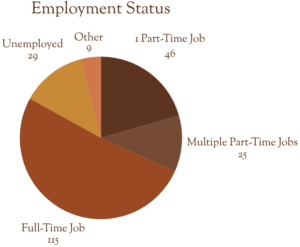
Despite 87% of people who filled out the survey indicating they were employed, only 27% felt that their income was enough to support the cost of living in the area.
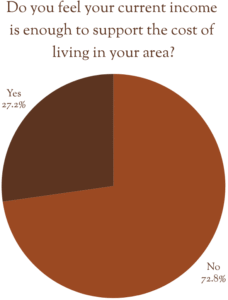
It is important to note that this is not just a Southeastern Ohio issue, but that the higher cost of living has affected millions of young adults all across the United States. While rural living is cheaper than living in a city, cost breakdowns of the area are very similar. Although rent is considerably higher in big cities than small towns, the average entry level salary in Cincinnati is nearly $15,000 more per year than that of Zanesville, creating a 0.1% difference in the percentage of income needed for rent between the two cities.
Many people would be more than willing to pay an extra $500 per month in rent in exchange for a higher salary, better public transportation, faster internet, more diversity, and more social and entertainment opportunities – all things that a small town in Southeast Ohio struggles to provide.
All hope is not lost for the area though. The Youth Retention and Attraction Task Force was initially supposed to release a full report of their findings and plans for improvement to the Commission this month, but they have pushed back the release date to November. This will give the task force more time to develop a plan and hopefully make a larger push to reach out to more young people in the community to really hone in on the key issues that are causing them to leave.
They have already made great headway, as Bill Arnett revealed that their biggest focus for improving retention rates is increasing the entertainment options in the area. They are looking into adding additional dining options and larger food chains, as well as more indoor recreational activities to entice young people.
Arnett said “some of the ideas [the task force has] been talking about, we’re already researching and trying to put into action, even before [the report] is officially adopted”.
The work being done by the Youth Retention and Attraction Task Force signals a growing awareness among local leaders that attracting and retaining young people will require investment in social activities, diverse job opportunities, and a community culture that makes people feel heard and valued. The region’s rich history, strong sense of community, and affordable living can be powerful assets.
If Southeast Ohio can embrace innovation while preserving its roots, it has the potential to become not just a place people come from, but a place where young adults are excited to stay.
Last Updated on April 22, 2026 by AVC News