



CAMBRIDGE, Ohio (AVC News) — Cambridge city officials and residents engaged in an extended discussion Monday over the city’s newly installed Flock automated license plate reader camera system, with supporters citing its potential value to law enforcement and opponents raising concerns about privacy, data security, constitutional rights and the future use of surveillance technology.
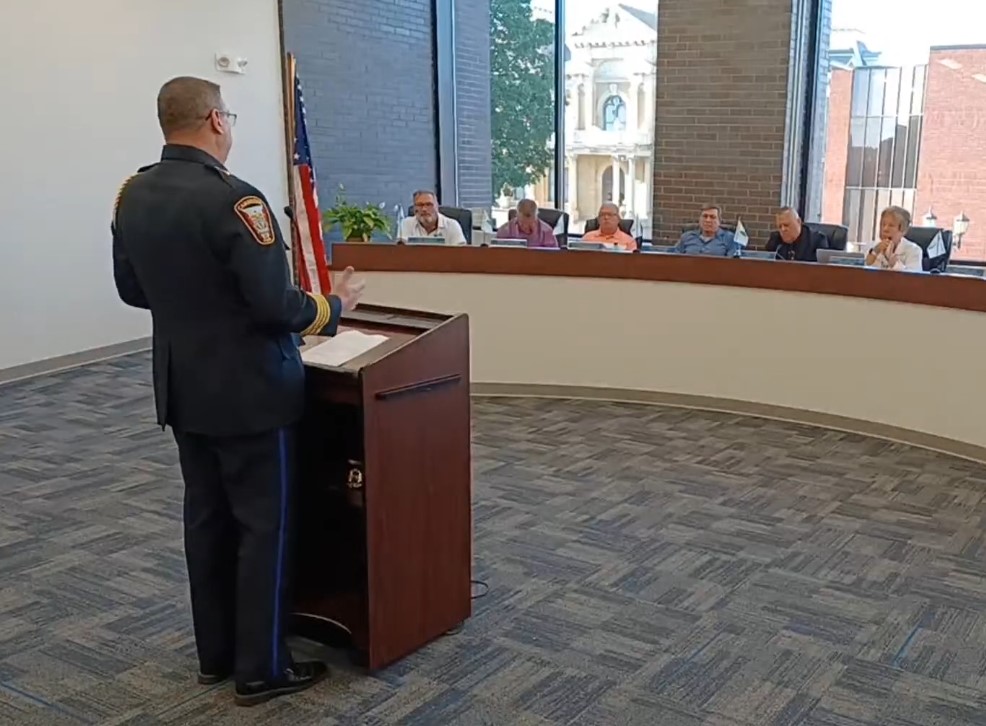
The discussion drew a large crowd to Cambridge City Council and began with Police Chief Dave Peoples and City Law Director Bill Ferguson explaining the system and the safeguards the city plans to use before residents addressed council during the audience portion of the meeting.
Peoples said the Cambridge Police Department budgeted for four Flock cameras during the previous year’s budget process. The department began working on camera placement and installation after the budget was approved.
The cameras are intended to serve as an additional investigative tool for law enforcement.
Flock cameras capture still images of the rear of vehicles and compare license plates against the National Crime Information Center database and other hot lists established by law enforcement agencies. Peoples said an alert from the system is only a starting point in an investigation and does not, by itself, provide probable cause for a traffic stop or other law enforcement action.
Officers must independently verify information provided by the system, including confirming the license plate and determining that the alert was not generated by a similar or partial plate number, he said.
Peoples said the cameras do not use facial recognition and do not issue traffic citations. The system can provide a suggested vehicle make and model, but he said the department does not receive vehicle ownership information through the cameras.
The department’s current data retention period is seven days. Peoples said that could be extended when necessary for an investigation, but he said he would not extend retention beyond 21 days.
Access to the system also will be limited. Peoples said supervisors and detectives will have access after the department completes training, while he and the department captain are currently the only users because the system is not yet fully operational.
Before conducting a search, users must select a reason from a list of approved investigative categories and enter a case number. The categories include offenses such as assault and domestic violence, burglary, child abuse and neglect, drug offenses, financial crimes, hit-and-skip crashes, homicide investigations, human trafficking, kidnapping, theft, missing or endangered persons, motor vehicle theft, sex offenses, stalking, wanted persons, weapons offenses and welfare checks.
Peoples said if a search does not fall within one of the approved categories, it will not be conducted. The reason for the search also must correspond with the department’s case report.
The department plans to audit searches every two weeks. Peoples said a transparency portal is also planned once the system is fully operational and personnel have been trained. The portal is expected to include the department’s policy, information about data retention and search history.
Three cameras were operational at the time of Monday’s meeting, according to Peoples. They are located at Southgate and Georgetown, State Route 40 near Riesbeck’s and State Route 40 at Dewey Avenue. A fourth camera at First and Steubenville Avenue was not yet operational.
The license plate reader cameras capture inbound traffic entering Cambridge rather than vehicles leaving the city.
The camera at State Route 40 and Dewey Avenue also includes a rear-facing live-view camera. Peoples said that camera does not have license plate reader or facial recognition capabilities and will not be shared with other agencies. Officers would have to manually review footage from a specific period when needed.
Peoples described the cameras as a force multiplier and an additional set of eyes for the department.
“We are Cambridge,” Peoples told those attending the meeting. “We will be responsible with this system because we know how much harm it can do if used wrong.”
Ferguson told council that automated license plate readers largely use technology to perform something police officers can already do manually by observing and running license plates.
He said police officers can currently run license plates without needing a specific reason and that the cameras allow law enforcement to conduct similar activity on a larger scale.
Ferguson said he had discussed the system with Guernsey County Prosecutor Lindsey Angler, whose office has had access to Flock cameras in the county for more than a year. According to Ferguson, Angler told him the cameras have been effective in assisting investigations and locating suspects and that she was not aware of complaints alleging constitutional rights violations involving the county’s use of the cameras.
Ferguson said the system also can help law enforcement track vehicles between jurisdictions. However, he emphasized that a Flock alert alone does not establish grounds to stop a vehicle and officers must independently develop additional information before taking action.
Both Ferguson and Peoples said restricting access and monitoring the use of the system are important safeguards against potential abuse.
Residents then took turns addressing council, with speakers offering both support and opposition to the cameras.
Several residents said their concerns were not directed at the conduct or integrity of Cambridge police officers but instead centered on the data network created by automated license plate readers and the possibility of how information could be used in the future.
Speakers questioned how often the database would be searched, why searches would be conducted and whether the department’s current safeguards would continue to protect residents as laws, technology and city leadership change.
Privacy and constitutional concerns were raised repeatedly. Some speakers questioned whether the cameras violate Fourth Amendment protections, while others asked whether the technology could eventually be used to monitor or reconstruct an ordinary person’s movements and daily routine.
Several residents said they were concerned about information being stored in the cloud and potentially being accessed by third parties or exposed through a security breach. Others raised questions about Flock as a private company and what control the city has over information collected through its system.
Some residents also expressed concern about the ability of technology to evolve beyond its current use, asking what the city or future leaders could do with the system years from now.
Artificial intelligence was another topic raised during public comments. Several speakers described the increasing use of AI and surveillance technology as a potential slippery slope and said they were concerned about how such systems could be used in the future.
One resident compared the cameras with personal mobile devices, saying people can choose whether and how to use a phone but do not have a choice about whether their vehicle is captured by a public license plate reader.
Another speaker said the issue had affected trust in city government because of concerns about how late some residents learned about the planned cameras. Others called for greater transparency about funding, data access and the city’s process for approving and implementing the system.
Questions were also raised about whether the cameras address a specific problem Cambridge police cannot already handle with current staffing and resources. Some speakers asked whether the money spent on the technology could instead be used to hire additional personnel.
Others questioned whether the cameras would prevent crime or provide enough benefit to justify their cost, arguing that criminals could alter their behavior or avoid known camera locations.
Not everyone opposed the technology.
Several residents voiced support for Cambridge law enforcement and said officers should have access to appropriate tools needed to protect the community.
Supporters said technology can help overcome limitations involving human error and reaction time and could provide officers with a valuable resource when investigating crimes and responding to threats.
One speaker said law enforcement cannot see everything occurring in the community and that additional tools could help officers work more effectively. Another said criminals do not follow the law and that police need effective resources to help keep residents safe.
Some supporters also said the safeguards outlined by Peoples were important and urged the city to ensure those protections remain in place.
The discussion repeatedly returned to the balance between public safety and individual privacy.
Ferguson said earlier in the meeting that the city has a responsibility to protect residents’ rights while also providing law enforcement with tools that can help keep the community safe.
He said he was not aware of a court decision finding automated license plate readers unconstitutional simply because of their use, although he noted that legal questions surrounding the technology continue to develop.
Ferguson said expectations of privacy can differ depending on the circumstances, including between activity occurring inside a home and activity occurring in a vehicle traveling on a public roadway.
Council President Jeff Leonard thanked residents for attending and participating in the discussion. At the conclusion of the public comment portion, he asked Peoples to remain after the meeting so residents could speak with him individually and ask additional questions about the system.
Evancho later clarified that City Council did not hold a separate vote specifically approving the Flock cameras. He said the cameras were included within the broader police department budget and that council members do not review every individual equipment purchase within department budgets.
He said the discussion demonstrated the need for the city to continue examining how emerging technology and the data it generates are handled.
The meeting also included other city business, including approval of transfers and appropriations, authorization for the administration to commit up to $90,000 from the user fee reserve fund as local leverage for a 2026 FLEX grant project and authorization to apply for Ohio Bureau of Workers’ Compensation safety intervention grant funding for equipment for the Cambridge Fire Department.
Mayor Tom Orr also reported on paving in East Cambridge and other ongoing construction projects and welcomed Midtown Market and several new businesses to downtown Cambridge.
During the meeting, Wolverton announced that he will resign from his position as Third Ward councilman effective Sept. 30 after more than 10 years on council. Wolverton thanked his constituents, fellow council members, city officials and his family for their support.
Council members thanked Wolverton for his service and said they looked forward to continuing to work with him in the future.
Last Updated on September 15, 2026 by AVC News